InTASC #1
Learner Development: The teacher understands how learners grow, and develop, recognizing that patterns of learning and development vary individually within and across developmentally appropriate and challenging learning experiences.
The teacher understands how learners grow and develop; recognizes that patterns of learning and development vary individually within and across the cognitive, linguistic, social, emotional, and physical areas; and designs and implements developmentally appropriate and challenging learning experiences. These two artifacts showcase my understanding and observation records related to how students grow and develop within a variety of settings and contexts. Within these artifacts, it also highlights how I am able to to use this information and my understanding to plan and implement desired recommendations for improvement and success within the observed students. This connects because it directly shows my abilities to understand, record, and implement lessons, activities, and recommendations based on students' development and areas for growth.
InTASC #5
Application of Content: The teacher understands how to connect concepts and use differing perspectives to engage learners in critical thinking, creativity, and collaborative problem solving related to authentic local and global issues.
The ability to understand and connect content to students' learning and desires in meaningful and effective ways. This lesson spans a couple of weeks and requires students to be active observers in their environment and how they affect it. Students participate in virtual exploration and videos that explore population, overcrowding, and how population affects natural resources. Afterwards, students will then take home a packet that allows them to observe and record the natural resources they are using in their everyday lives. After this students will put their data into perspective on a larger scale before beginning to research and explore how natural resources are affected and controlled globally but also more locally by exploring why the Gulf of Maine is warming and the impacts humans are having on that. Finally, with all of the information the students have learned and gathered, they will participate in a “town hall meeting” to debate the benefits or downfalls of merging or buying the next town over, expressing what that means for population and natural resource distribution for the people in the current town. This connects to this standard because it allows students to collaboratively problem-solve relating to a local issue while also utilizing what they have learned about it on a global and personal scale. I think this also shows how I can connect content to a variety of perspectives because it does not just focus on natural resources within the U.S. and explores topics such as overpopulation or not having enough natural resources to meet the needs of those in a particular region.
InTASC #9
Professional Learning and Ethical Practice: The teacher engages in ongoing professional learning and uses evidence to continually evaluate his/her practice, particularly the effects of his/her choices and actions on others (learners, families, other professionals, and the community), and adapts practice to meet the needs of each learner.
The desire and ability to seek out professional learning and feedback that evaluates and enhances an educator's practice or decisions that meet the needs of and have a positive impact on others. This artifact is one that incorporates the use of technology. At my first middle school field placement site they utilized technology a lot, but I felt like it was a lot of individual technology use. Due to what I had already observed and knew about the students, this lesson was created to be a group interactive activity. A variety of QR codes were placed around the room, and students were instructed to use their computers to take a picture of the QR codes. These codes would bring them to a YouTube ad that students would need to determine if it was ethos, pathos, or logos. A short slide on how to identify what the differences between the three are was presented before the lesson, and a class discussion was held after the lesson. Due to this being my very first lesson I had ever implemented, and the first interactive group lesson I had seen the students have within this field placement, I wanted to know what the students felt about the lesson as well as how I implemented it, so I had students fill out a teacher assessment survey at the end of the lesson. This lesson connects with this standard because of my use of the teacher assessment survey. I have a strong desire to immediately assess how things were presented and absorbed by students so that I can change what may need to be changed or implement more of what worked in my next lessons. Since it was my very first implemented lesson, their feedback meant a lot to me, and I got a lot of useful feedback that I was able to implement in my future lessons. I also decided that the implementation of the survey was so useful that I utilized it again in different ways, not just as a survey for my later lesson implementations.
InTASC #2
Learning Differences: The teacher uses understanding of individual differences and diverse cultures and communities to ensure inclusive learning environments that enable each learner to meet high standards.
The teacher uses understanding of individual differences and diverse cultures and communities to ensure inclusive learning environments that enable each learner to meet high standards. This artifact is a game that was created based on a book called FLIPPED. This is an adapted version of Cards Against Humanity where there are a stack of black cards and a stack of white cards. For each white card students must match a black card to it. This pairing showcases students' understanding of explicit or inferred meaning within the text. This connects to this standard because there are hundreds of different pairings and variations of the game that can be made or played. Students also verbally have to express their reasoning for the pairings which allows students to give vastly different explanations for the same pairings. Students' backgrounds, cultures, and prior knowledge all contribute to their reasoning and understanding of the paired phrases or words, allowing all students to be successful and engaged within this activity.
InTASC #6
Assessment: The teacher understands and uses multiple methods of assessment to engage learners in their own growth, to monitor learner progress, and to guide the teacher’s and learner’s decision making.

The understanding and use of multiple means of expression and assessments for students to show their knowledge. This lesson is in relation to a historical fiction book students read prior or during this lesson in order to complete this assignment. Students will create a scrapbook that compares the various aspects of a historical fiction book with the actual historical references. This is a 3-to-4-page scrapbook where students are allowed to choose what information is being presented. Since there are a variety of different aspects that can be compared, it is unlikely that all students' scrapbooks will look the same. Not only do students get a choice in what information they choose to use, but they also get to choose how they want to create the scrapbook. That could be by hand, digitally and then printed, or as a slideshow. Not all students will make the same connections or inferences even if the same pictures or aspects are being presented. Due to all these differences, there is an overall rubric that students must follow, but their means of expression is completely up to them, which I feel aligns well with this standard.
InTASC #3
Learning Environments: The teacher works with others to create environments that support individual and collaborative learning, and that encourage positive social interaction, active engagement in learning, and self motivation.
The teacher works with others to create environments that support individual and collaborative learning and that encourage positive social interactions, active engagement in learning, and self-motivation. This artifact is an entire document that showcases my intended environmental supports and how I plan to implement and communicate that with students, as well as a family handout that is presented to guardians so that we are all on the same page in providing all students in the classroom a positive, efficient, and inclusive learning environment. This plan also requires the collaboration and implementation of some of these ideas and expectations at school while allowing for consistency through all areas of the school.
InTASC #7
Planning for Instruction: The teacher plans instruction that supports every student in meeting rigorous learning goals by drawing upon knowledge of content areas, curriculum, cross-disciplinary skills, and pedagogy, as well as knowledge of learners and the community context.
The ability to plan lessons and activities that support the needs of all students by considering the diverse abilities and learning styles of all learners to provide the best possibility for success. This artifact is a lesson outline that supports students in Grade 4 with multiplication of multi-digit numbers. This artifact matches the standard because it was created to fit the needs of all students within the class by utilizing a variety of tools for deeper understanding. The use of visuals, student handouts, manipulatives, and sequenced difficulty levels within the progression of the problems helps meet the needs of a variety of different students within the class.
InTASC #10
Leadership and Collaboration: The teacher seeks appropriate leadership roles and opportunities to take responsibility for student learning, to collaborate with learners, families, colleagues, other school professionals, and community members to ensure learner growth, and to advance the profession.
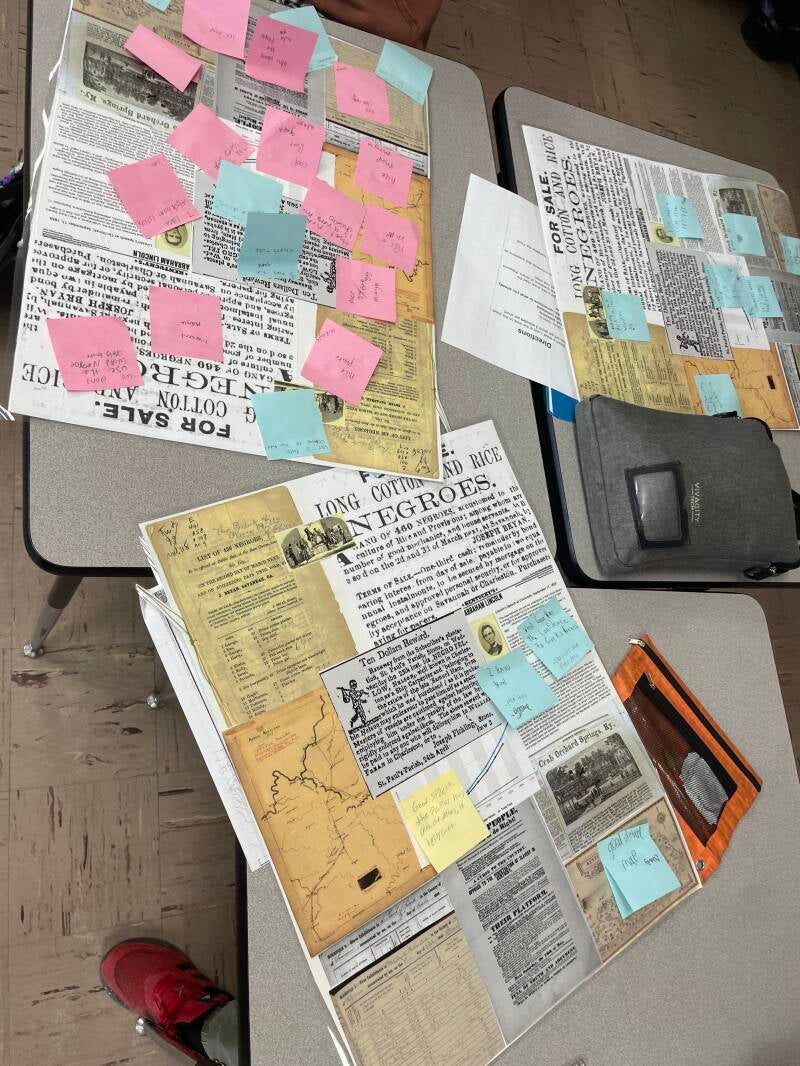
The desire and ability to seek out and accept opportunities to take responsibility for students as well as seek collaboration and feedback from families and colleagues to provide students with exemplary growth and opportunities for success. This artifact is a collection of text, documents, and pictures all put together as a collage on poster boards. There is a total of 9 posters, 3 of each kind. These posters were themes and information that explored different historical references related to pre-Civil War/Civil War, slavery, abolitionism, and what it meant to be “free” during this period. Students were instructed to explore the posters in groups, with each group receiving a different kind of poster. While they were exploring the poster, they were to write thoughts, questions, and reactions that they had to what they were seeing on the posters. After all students got some time to explore, they would then switch their poster with another group's poster, leaving their sticky notes on. The groups with their new poster were now expected to not only create thoughts, questions, and reaction sticky notes for what they were eyeing on the new poster but now they were also to respond to their peers' sticky notes from the previous group. Groups would keep switching until students had a chance to explore all posters, and then we would go over what some of the sticky notes said as a class. This connects to this standard because this was a lesson I did not come up with on my own. My mentor teacher had attended a professional development seminar the day before, later bringing up this idea to me. While she was at the seminar, she had listened to an educator discuss this type of lesson, which she was intrigued by, so she took notes. She had never heard of or implemented a lesson like this before but had brought the idea up to me in excitement to try it. Since this was new to her as well, she did not have a full idea of what it would look like, how it would be best implemented, or how it would realistically look as a lesson. After a lot of discussion and collaboration with my mentor teacher, I was now also intrigued by the lesson idea, so I volunteered to create these text sets. Since this was something new for the both of us, the creation of these text sets required a lot of online research, researching the educator who presented the idea at the seminar, and back-and-forth communication with my mentor to make sure I was creating what she was envisioning. I believe this lesson showed my desire and ability to take action and responsibility over a lesson design as well as my ability to communicate with colleagues and research a variety of information to create the most beneficial text sets for the intended lesson.
InTASC #4
Content knowledge: The teacher understands the central concepts, tools of inquiry, and structures of the discipline(s) he or she teaches and creates learning experiences that make the discipline accessible and meaningful for learners to assure mastery of the content.
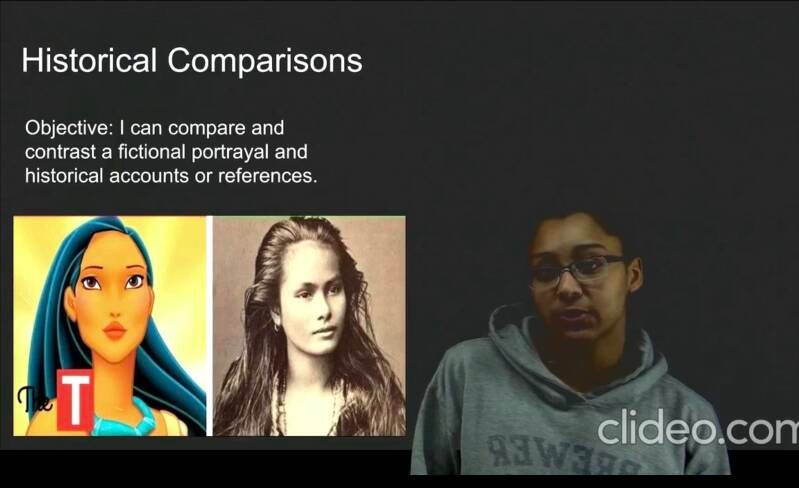
The teachers' understanding of the concepts, means of inquiry, and aspects needed to connect students to content meaningfully. This artifact is a digital lesson that students may follow along with at home utilizing a flipped lesson design. This helps students compare and contrast historical reference pictures to those of historical fiction book pictures, identifying the different discrepancies. This connects to this standard because it makes learning accessible to students who may be absent or who struggle to focus on class. By having this lesson done digitally, students may pause or rewind as they need to be able to gather and practice the necessary information, which makes the content easy to follow along.
InTASC #8
Instructional Strategies: The teacher understands and uses a variety of instructional strategies to encourage learners to develop deep understanding of content areas and their connections, and to build skills to apply knowledge in meaningful ways.
The use of a variety of instructional strategies that are carefully tailored to the students and to each class that helps students learn and connect to the content and apply it in multiple contexts. This artifact is a lesson that I implemented while student teaching that utilizes a variety of instructional strategies to help students identify different aspects of a historical reference within several pieces of text. Students were presented with a packet that had 5 different pieces of text, all from different historical fiction books. The objective for this activity was for students to go through each text highlighting the different aspects of a historical reference within that text. They used 3 different colored highlighters to identify the different aspects of the historical references that could be found in the text; the packet itself was chunked into a variety of texts to give the students a wide array of context to see the historical references being presented, and I worked with the class to work through the first two problems together, adopting a "we do, you do" method of delivery. This connects with the standard because it uses a variety of instructional strategies all within one activity. By having the color-coded highlighters, students are able to see and identify the different historical aspects, making connections to real history easier. The use of the "we do, you do" method also worked well for students who may have a hard time identifying the different aspects if I had left them to figure it out by themselves without explicitly showing the examples I was expecting to see as a group before letting them attempt the lesson on their own.
Development Plan
Here you will find a list of my personal development plans. These consist of the goals and actions I plan to take to reach these goals in a variety of areas related to the InTASC standards listed above, as well as my personal self-assessment form that can be located below.